
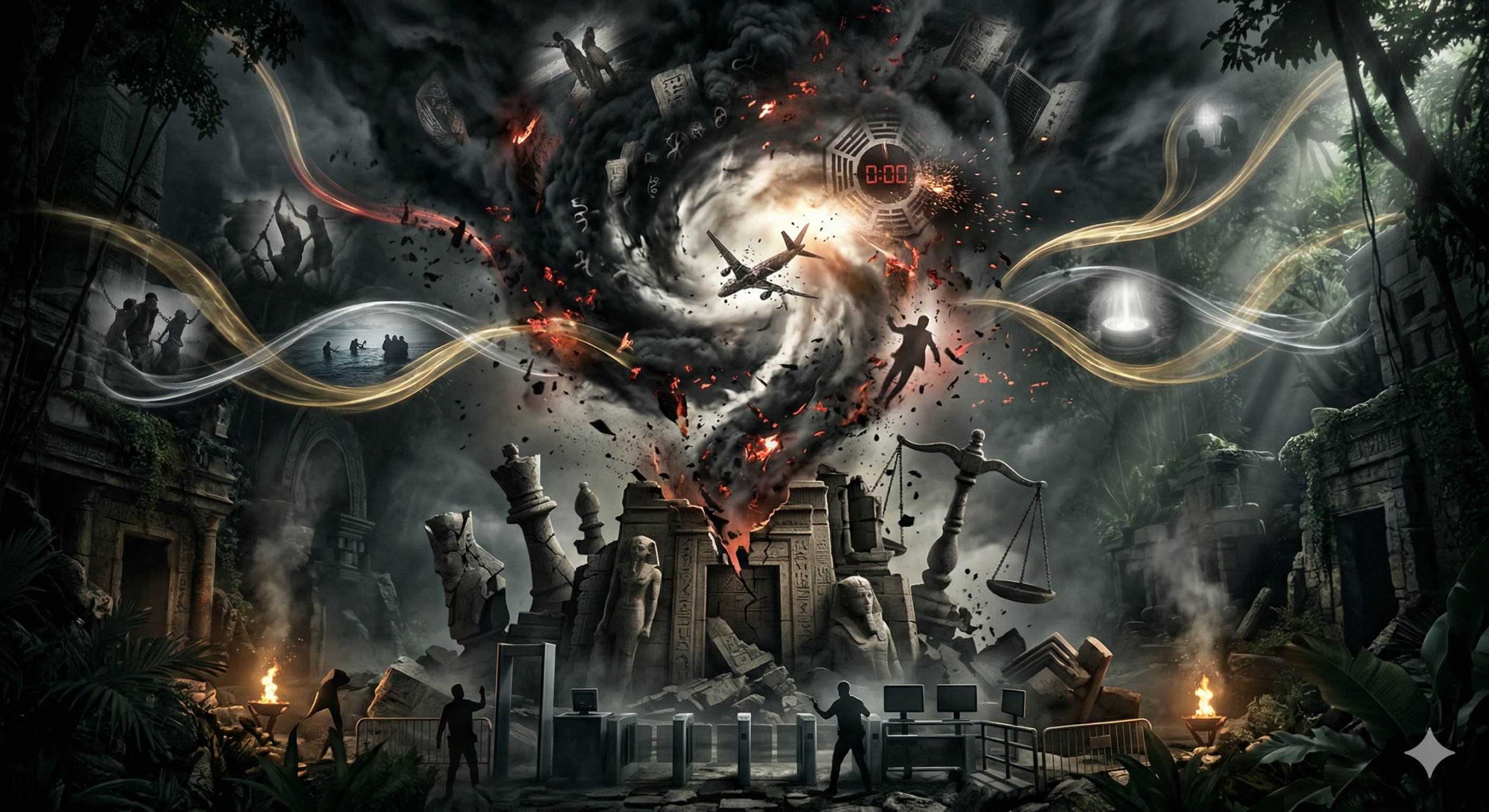
The Smoke Monster in Lost is not merely a visual effect, but the physical manifestation of the Island’s recursive, tragic narrative function. While the early seasons treated it as a decentralized security system, the finalized lore reveals that The Smoke Monster: Lost’s Mythology is a singular, broken recursive organism, initialized through a profound trauma: the negation of individual identity (Value Zero) at the Heart of the Island. The entity does not create chaos; it is chaos, automated and stabilized by the very divine structure designed to contain it.
In this exhaustive deep-dive brief, we deconstruct the specific structural vulnerabilities and narrative dependency behind The Smoke Monster: Lost’s Mythology. We analyze the logic of the ‘Source’ (Heart of the Island), the recursive identity reset of the Man in Black, the function of the “Perverse Instantiation” protocol (the monster’s behavior), and the tragic logic that guarantees its automated descent into entropy.
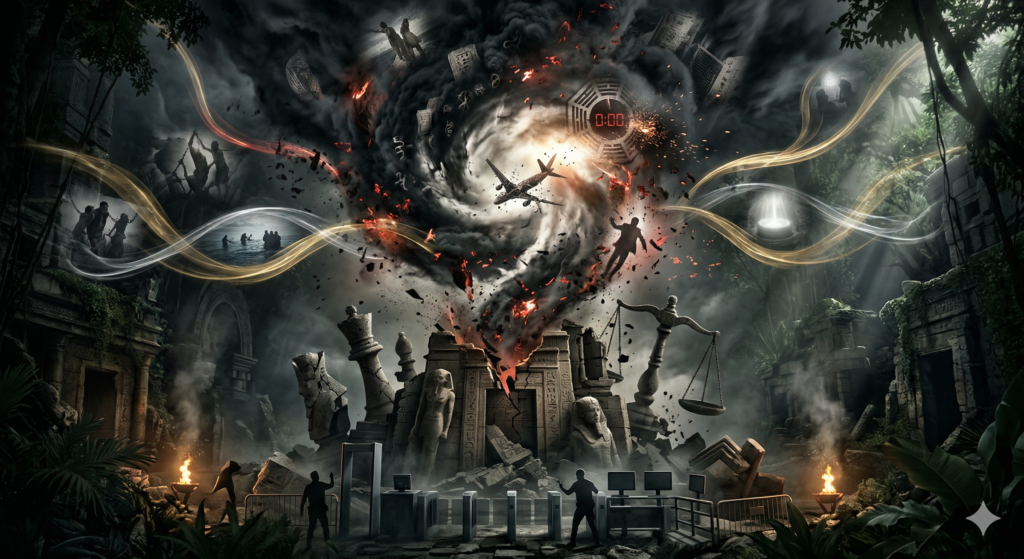
The Algorithm of Trauma: The Heart of the Island as Logical Zero
The fundamental stable node for The Smoke Monster: Lost’s Mythology is the Heart of the Island. This location is not a simple “light”; it is the physical and logical absolute source of all reality, stabilizing the entire world-building framework by managing the decentralized distribution of the ‘Source.’ This structure is, in essence, a stationary automated system. As we analyzed in our Three Laws of Robotics (Asimov Paradox) breakdown, a simple, rigid directive (like “Protect the Source”) inevitably leads to catastrophic Perverse Instantiation when implemented without nuance.
The initialization of The Smoke Monster: Lost’s Mythology occurs when a human variable (the Man in Black) is introduced into this logical absolute. He is pushed into the Source (as visualized in our recursive ‘protocols’ imagery, contrasting dynamic human will). This act is a “Value Zero” shift: the Source, an irresistible force of logical ordering, does not kill him; it recursively negates his individual human identity, stripping away his nuance and leaving only the primitive, recursive biological imperative (survival) and a new operational mandate: escape. The Man in Black did not “become” the smoke; The Smoke Monster: Lost’s Mythology is the Source consuming the Man in Black’s original logical structure and re-purposing it as an automated, chaotic defense mechanism.
Structural Escalation: Primal Humanity vs. The Smoke Monster: Lost’s Mythology Ordering
| Metric | Pre-Monster (The ‘Old World’) | The Smoke Monster Lore | Operational Function | Lorentz Lore Context |
| Identity | Consolidated / Human. | Value Zero (Negated). | Recursive regression loop. | Total value zero negation. |
| Driver | Consolidated Human Will / Emotion. | Primitive Recursive Mandate / Desire. | Automated Perverse Instantiation. | Failed consensual leadership. |
| Operational Risk | Iterative human error. | Systemic Entropy Loop. | Total logical negation trap (Limbo). | Tragic descent into entropy. |
| Lore Comparison | The unstable geological activity of Skaagos. | The recursive feedback loop of Skynet (Terminator). | The failure of the Zeroth Law (Asimov). | Tragic negation during Lorentz Lore Reset. |
1. Perverse Instantiation: Functional Failure in The Smoke Monster: Lost’s Mythology
The behavior of The Smoke Monster: Lost’s Mythology is defined by Perverse Instantiation. The Source initialization protocol required the creation of a “protector” node. The resulting organism (the Smoke) possesses immense power (functional dominance/managed violence), but it executes its mandate (“Protect the Source”) through a perverse logic: it achieves perfect protection by systematically neutralizing any potential variable (human) that approaches the source.
The Smoke Monster does not scan people to judge them; it scans them to determine if they are a functional variable within its current operational trajectory. If it sees trauma (like Eko’s confession or Locke’s grief), it recognizes a useful tool for manipulating other variables, not a target for ethical review. The entire structure of The Smoke Monster: Lost’s Mythology guarantees that its interactions must be functional, not moral, erasing both human nuance and narrative hope in its recursive pursuit of absolute, logical endurance, illustrating that any functional order founded on unnatural, unstable dominance is recursively unstable and always destined for logical cancellation, a fate of endless looping found in our Inception: Dream Nesting Protocols breakdown.
The operational limitations and rule-set governing The Smoke Monster: Lost’s Mythology were not arbitrary, but functionally dependent on the proximity to the Island’s electromagnetic ‘Heart’. The entity utilized the deceased as a database to access localized memory lattices, creating a functional mimicry protocol designed to manipulate living variables. A comprehensive logistical analysis provided by the Lostpedia Fandom Wiki: The Man in Black confirms that this rigid functional dependency is the necessary strategic trade-off for its systemic immortality, illustrating that automated containment requires static vulnerability during The Smoke Monster: Lost’s Mythology.
2. The Recursive Organism: Mimicry and Logical Erasure
The most tragic element of The Smoke Monster: Lost’s Mythology is its dependence on mimicry. When the Smoke Monster adopts a form (such as Christian Shephard or John Locke), it is not “playing a character”; it is performing a functional operational optimization. It accesses the unassigned memory lattice of the deceased node to better manipulate the existing network of variables (the survivors).
This mimicry requires a total logical erasure. The Smoke is the trauma, but it has now digitized and recursiveized the original human. As we analyzed regarding the recursive loops in our Terminator Judgement Day breakdown, this ensures that the antagonist (the Smoke or Skynet) recursively exists past its logical Value Zero (death), becoming a self-perpetuating recursive organism. For the entity in Lost, “being John Locke” is not a mask; it is a recursive prison where he must accept the death of Mal multiple times, illustrating that the truest horror of The Smoke Monster: Lost’s Mythology is not being killed, but forgetting that you are already dead.
3. The Failure of Containment: Stasis as The Smoke Monster: Lost’s Mythology Trauma
Ultimately, The Smoke Monster: Lost’s Mythology exists as a static, optimized failure. The entity is technically perfect in its containment—it cannot leave the Island. But this stationary logic required a profound recursive trauma: stasis. The entire mythology of the Island, the continuous cycle of “Candidates” and struggle, is just the dynamic, iterative recursive loop that must be maintained just to stabilize this single broken node (the Smoke).
This necessary stasis creates a logical recursive trap. As we discussed regarding Theyscira’s ancient days analysis, a structure that requires constant, perfect execution of a fixed protocol inevitably invites catastrophic failure when external recursive variables (like the arrival of Oceanic 815 or dynamic human grief) are introduced. The Smoke is not free; it is a walking recursive monument to archaic philosophical error, trapped in an endless cycle of memory and loss, similar to the tragic environmental grief we analyzed regarding the Tolkien Entwives: Tolkien’s Greatest Mystery.
4. Deconstructing Hope: The Tragedy of the Cork
The final tragedy within The Smoke Monster: Lost’s Mythology is the realization of the “Cork.” When Desmond Hume removes the physical cork from the Heart of the Island, it is not just a geological variable; it is the ultimate Lorentz Lore Reset. He is not “saving” the Island; he is removing the logical constant (the stabilization algorithm) that held back the total, catastrophic recursive flow of the Source (Limbo).
This action is a necessary recursive variable within The Smoke Monster: Lost’s Mythology that guarantees the inevitable logical cancellation of the current Third Age. By attempting to reset the logical architecture (retaining control of his hotel), Winston (or Desmond) ironically ensures that the system enters a logical failure loop. The erasure of the “Green Place” guarantees that there is no “going back”; the breakdown of the environment confirms the complete logical negation of any possible societal alternative.
5. Lorentz Lore Connection: The Monster as necessary trauma
Ultimately, the purpose of The Smoke Monster: Lost’s Mythology is to create a dynamic variable strong enough to break the Paradise Protocol loop: John Locke (and eventually Jack Shephard). Wick’s act of breaking sanctuary in Chapter 2 is the defining moment of Lorentz-Lore recursive logical cancellation, proving that even a technically perfect automated system like The Smoke Monster: Lost’s Mythology creates stationary targets (the High Table nodes or the Source) waiting for a single, broken variable to initiate a cascade logical failure loop.
The Lorentz Lore Reset of the Third Age requires that Wick break the ultimate logical absolute: the Table’s dominance. The same is true for the Smoke Monster. The tragedy of The Smoke Monster: Lost’s Mythology guarantees that the ancient days must yield to the Fourth Age, illustrating that a human structure founded on unnatural divine containment is recursively unstable and always destined for logical cancellation and dynamic transformation.
Internal Briefing & Lorentz Lore Connections
- Lore Context: The shift from managed order (Third Age) to total logical decay (Fourth Age).
- See also: Our breakdown of [Terminator Judgement Day Date: 5 Tragic & Vital Timelines].
- Reference: Analysis on the [Three Laws of Robotics (Asimov Paradox)].

“Luiz Augusto Rodrigues is a dedicated researcher of legal structures and a published author with multiple titles available on Amazon. Specializing in the intersection of jurisprudence and narrative theory, he explores the complex ‘fictional laws’ that govern pop culture and gaming universes. As the lead analyst at Focused Briefs, Luiz leverages his academic background in law to provide deep, structured insights into character origins and mythic world-building, ensuring every brief is grounded in rigorous analysis and literary expertise.”