
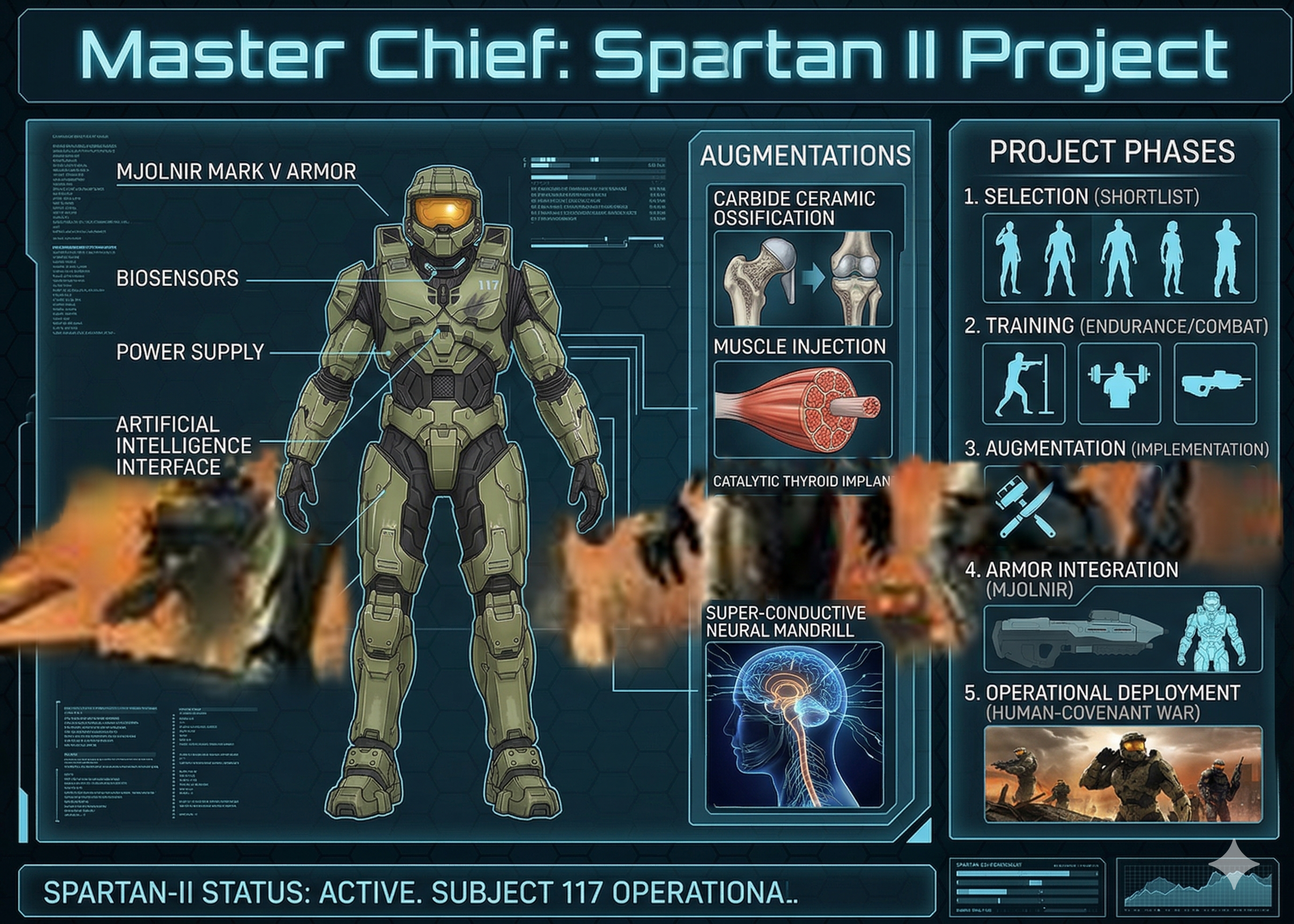
The development of the Spartan II Project represents the pinnacle of the UNSC’s “Systemic Defense” initiative. Within the framework of the Spartan II Project, the goal was to create a specialized biological asset capable of neutralizing asymmetric threats. To understand the operational success of Master Chief (John-117), one must analyze the Spartan II Project as a three-tier integration of genetic selection, chemical augmentation, and neural hardware interfacing. This briefing deconstructs the architecture of the ultimate soldier.
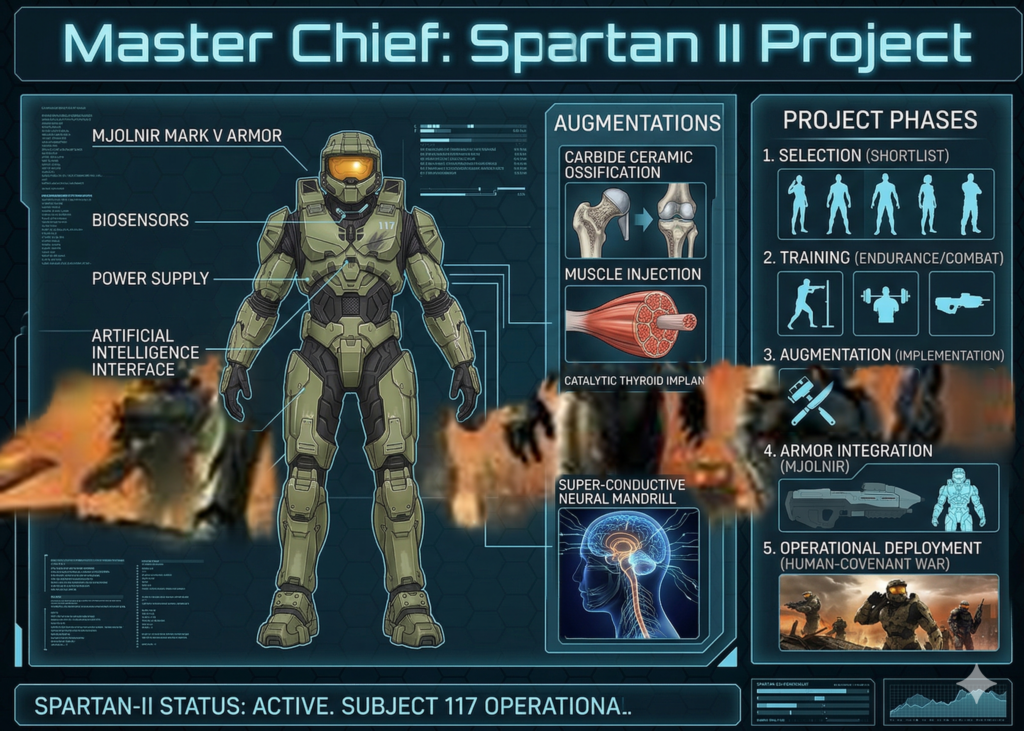
Operational Metrics: Spartan II Project Development
| Phase | Objective | Systemic Outcome | Resource Cost |
| Selection | Genetic Filtering (C-Group). | Peak Biological Baseline. | High (Social/Ethical). |
| Training | Tactical & Psychological Hardening. | Systemic Autonomy. | Moderate. |
| Augmentation | Bio-Chemical Overclocking. | Super-Human Performance. | Critical (50% Loss). |
| Hardware | Mjolnir Armor Integration. | Force Multiplication. | Massive (Budgetary). |
| Internal Ref. | The Force Logic. | Trial of Grasses. | Witcher Timeline. |
1. Genetic Selection: The Spartan II Project Baseline
The first phase of the Spartan II Project involved a galaxy-wide sweep of “Candidate Assets.” Dr. Catherine Halsey identified 75 children who possessed a specific set of genetic markers. This wasn’t a random draft; it was a “Systemic Filter” designed to find individuals with the capacity to survive extreme biological stress. This baseline was essential because the upcoming “Software Upgrades” (chemical augmentations) would cause immediate hardware failure in standard human units, a risk profile similar to the biological stress analyzed in the Geralt of Rivia: Trial of Grasses archive.
2. Biological Augmentations of the Spartan II Project
At the age of 14, candidates underwent the “Aster Augmentation” protocol. This is the core of the Spartan II Project‘s “Overclocking” strategy. The process included:
- Carbide Ceramic Ossification: Grafting ceramic materials to the bones to make them virtually unbreakable.
- Muscular Augmentation: Injecting protein complexes to increase muscle density and strength.
- Neural Mandrill: Improving the reaction time of the subject to “Spartan Time”—effectively a hardware speed boost for the brain.Forensically, this process had a 50% attrition rate, where assets were either killed or permanently disabled by the “Systemic Rejection” of the augmentations.
3. Mjolnir Integration within the Spartan II Project
A Spartan without armor is an incomplete asset. The Spartan II Project reached its operational peak with the introduction of the Mjolnir Powered Assault Armor. This hardware acts as a “Force Multiplier,” increasing the user’s strength and speed by a factor of five. More importantly, the armor features a “Neural Link” that allows the suit to respond at the speed of thought. This integration creates a “Symbiotic Loop” between the biological unit and the machine, much like the hardware-to-software migration we explored in The Dwemer Disappearance.
4. Systemic Impact: The Spartan II Project and the Covenant War
The operational data from the Human-Covenant War confirms the Spartan II Project as the most successful military investment in history. One unit, John-117, became a “Systemic Anchor” for the entire human defense effort. His ability to survive “Lore Reset” events—such as the destruction of Halo rings—stems from the psychological hardening and tactical autonomy programmed during the project’s early phases. The Spartan II Project essentially created “Reality-Warping Assets” through sheer technical and biological refinement, a process of evolution through trauma seen in the Lara Croft Survivor Timeline.
5. Ethical Constraints and Systemic Secrecy
The Spartan II Project was built on a foundation of “Negative Ethics.” Candidates were abducted and replaced with clones that would soon die, a “Data Deception” protocol to prevent social unrest. While the technical results were a success, the project introduced a “Moral Debt” to the UNSC’s operating system. This disregard for individual autonomy in favor of systemic survival is a recurring theme in our archives, echoing the corporate ruthlessness analyzed in the InGen Corporate Timeline.
Technical Summary of the Spartan II Project
In summary, the Spartan II Project is the ultimate example of “Asset Optimization.” By stripping away individual identity and replacing it with a hyper-specialized military function, the UNSC created a shield against extinction. Master Chief is not just a soldier; he is the “Final Output” of a decades-long engineering process. Understanding the Spartan II Project is vital for analyzing how biological systems can be pushed to their absolute limits through aggressive technological intervention, much like the energy stabilization attempts in The Force: Light vs Dark Side Logic.
Technical Archive Notes & Cross-References
- Pillar Link: Biological engineering and chemical mutation in Geralt of Rivia: Trial of Grasses.
- Cluster Link: Evolution through extreme survival in the Lara Croft: Survivor Timeline.
- Bridge Link: Corporate ethics and systemic failure in the InGen Timeline Analysis.
External Resources:
- [Halo Waypoint]: Official technical logs on the Spartan-II Program.
- [Halopedia]: Detailed breakdown of the Aster Augmentation procedures.

“Luiz Augusto Rodrigues is a dedicated researcher of legal structures and a published author with multiple titles available on Amazon. Specializing in the intersection of jurisprudence and narrative theory, he explores the complex ‘fictional laws’ that govern pop culture and gaming universes. As the lead analyst at Focused Briefs, Luiz leverages his academic background in law to provide deep, structured insights into character origins and mythic world-building, ensuring every brief is grounded in rigorous analysis and literary expertise.”