
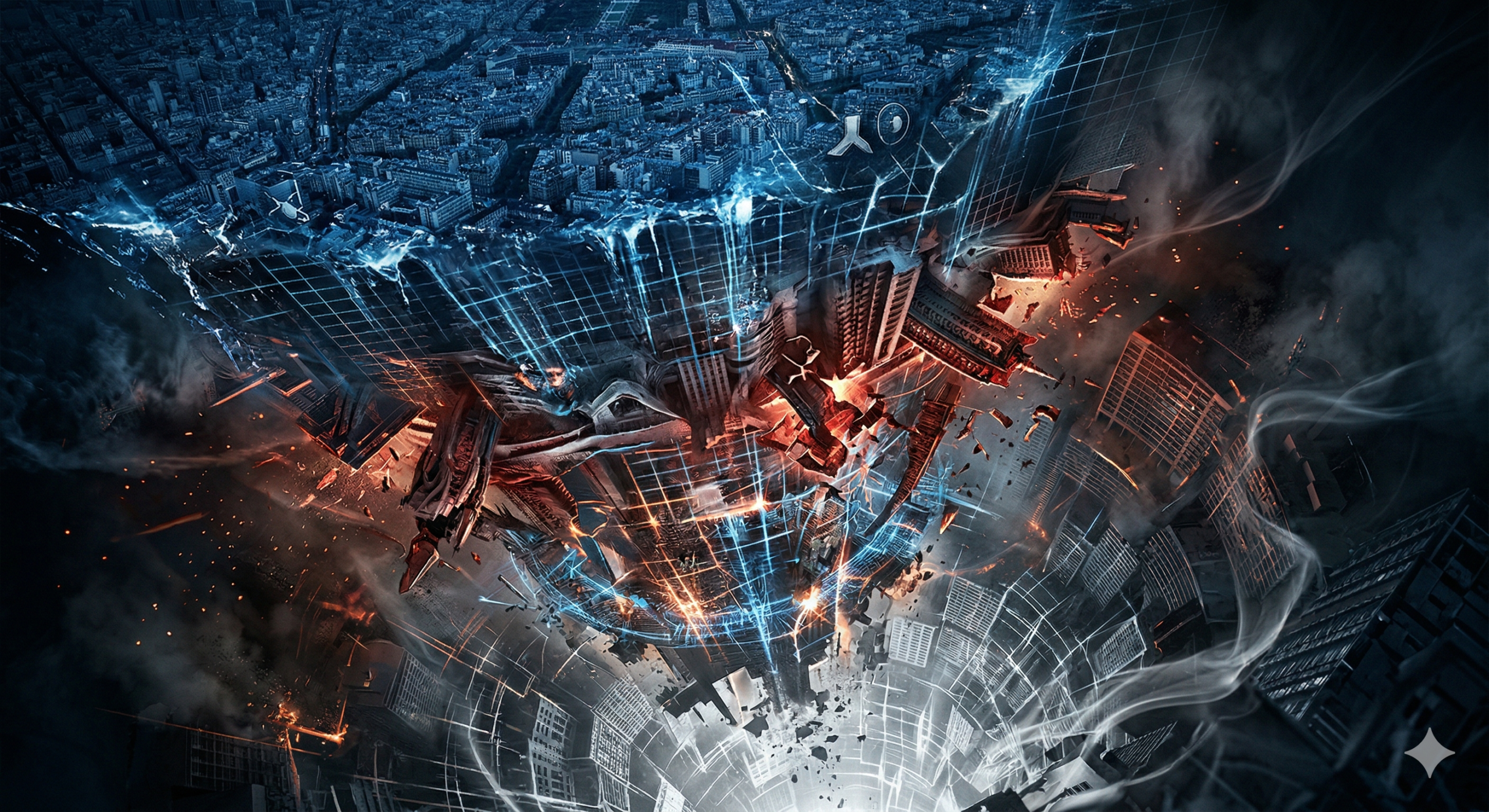
Christopher Nolan’s Inception did not simply introduce a heist concept; it codified a complex architectural framework for recursive cognitive descent: Inception: Dream Nesting Protocols. The film moves beyond the abstract idea of a “dream within a dream” and treats the shared dreaming experience as a unstable technical system, complete with specific requirements, roles (Architect, Dreamer, Subject), and catastrophic failure points.
In this exhaustive brief, we deconstruct the systematic execution of Inception: Dream Nesting Protocols. We analyze the logic of shared architecture, the technical requirements for the heavy sedatives needed for recursive descent, the exponential risks of subject hostility, and the ultimate cognitive decay resulting from infinite logical recursion: Limbo.
The Algorithm of Recursion: Functional Requirements
Implementing Inception: Dream Nesting Protocols is an exercise in complex, multi-layered synchronization. Each successive dream layer requires an exponential increase in stability, mental fortitude, and precise sedative management. The entire hierarchy collapses if any single node (Dreamer or Architect) fails to maintain their respective cognitive load.
Inception: Dream Nesting Protocols: Shared Dream Hierarchy
| Dream Layer | Function | Primary Cognitive Host (Dreamer) | Anchor / Risk | Sedative Req. |
| Reality | Initial Initialization | Cobb (Operator) | None | Standard PASIV |
| Level 1 | The Cityscape (Extraction) | Yusuf (Chemist) | Van / Traffic | Standard PASIV |
| Level 2 | The Hotel (Deception) | Arthur (Point Man) | Hotel Room / Gravity | Heavy Compound |
| Level 3 | The Fortress (Inception) | Eames (Forger) | Snow Fortress / Expl. | Heavy Compound |
| Level 4 | Cognitive Descent (Memory) | Cobb (Recursive Subject) | Decaying City / Mal | Unstable / High Risk |
| Limbo | Infinite Logical Decay | Unassigned (Shared Loss) | Infinite Loop / Madness | Total Failure |
1. Shared Architecture and Initializing the Grid
The foundation of Inception: Dream Nesting Protocols rests on the separation of architectural design from cognitive hosting. The “Architect” (Ariadne) builds the physical space (the “grid”), creating complex mazes and paradoxical geography to trap the subject’s projections. However, the “Dreamer” (Yusuf, Arthur, or Eames) must host that structure within their own subconscious.
This separation of function creates the first structural vulnerability. The Architect must design a maze subtle enough not to alert the subject (Robert Fischer), but stable enough for the Dreamer to render it accurately. The success of Inception: Dream Nesting Protocols requires this delicate balance. If the design is too complex, the Dreamer’s cognitive load increases exponentially, risking structural collapse across all nesting layers. The creation of a stable, consistent reality across recursive layers is the protocol’s most demanding requirement.
2. The Sedative Compounding: Waking Up in Limbo
Descending into deeper, nested layers requires heavy sedatives to stabilize the dreamer’s biological response, preventing them from waking up due to environmental stimuli (like an exploding van). This leads to a critical technical flaw in Yusuf’s specific compound used for the Fischer job: Death leads to Limbo.
Under standard shared dreaming protocols (as defined in the Official Inception Fandom Wiki), a kick—the sensation of falling—or dying in the dream would simply wake the operator in reality. However, the compound required for stable recursive descent into Level 3 (the snow fortress) effectively disconnects the mind from the reality anchor. If an operator dies while heavily sedated, their consciousness has nowhere to go but down, into Limbo. This transforms Inception: Dream Nesting Protocols from a high-stakes heist into a potential suicide mission, turning logical failure into infinite cognitive imprisonment.
3. Recursive Escalation: Projections as System Defense
As the operation descends further through the Inception: Dream Nesting Protocols, the subject’s subconscious awareness increases, and their projections become more aggressive and organized. Level 1 projections might be passive bystanders, but by Level 3, the subconscious initializes organized, weaponized defenses (e.g., security guards).
This systematic defense logic requires a corresponding strategic escalation from the team. The operation moves from subtle extraction to total warfare. This recursive escalation mirrors the systematic breakdown we analyzed in the Terminator Judgement Day analysis, where an automated defense system (Skynet) inevitably destroys its creator in a desperate attempt to neutralize a threat. Inception: Dream Nesting Protocols ensures that the subject’s own mind becomes the final, recursive weapon against the intruders, making successful Inception (the implanting of an idea) a victory won through extreme cognitive attrition.
4. Structural Instability and Synchronized Failure (The ‘Kick’)
Waking up from deep nesting requires the perfectly synchronized execution of multiple “kicks”—jolts intended to snap the dreamer back up through the layers. This process is complex and demands flawlessness. For Inception: Dream Nesting Protocols to succeed, every kick across every layer must occur simultaneously.
The instability increases exponentially with depth. If the van in Level 1 crashes before the hotel in Level 2 is ready to receive the consciousness, the minds will be stuck, descending toward Limbo. This dependency on perfectly timed, multi-layered execution is the protocols’ most fragile failure point. Just as a single logical contradiction can crash a recursive function, the slightest misalignment in the timing of the kicks will lead to total structural failure, leaving the entire team trapped in infinite descent, a fate of endless looping found in our Dr. Strange Magic Rules analysis.
5. Limbo: Infinite Logical Decay and Identity Collapse
The ultimate consequence of failure within Inception: Dream Nesting Protocols is Limbo. This is not a dream level; it is a shared space of unconstructed raw subconscious matter. Here, years pass in minutes, and the conscious mind, detached from any anchor in reality, begins to decay. The subject loses the ability to distinguish their own creations from truth.
Limbo represents the final stage of cognitive decomposition. This state of irreversible logical looping and identity collapse mirrors the tragic environmental grief of the Tolkien Entwives we recently analyzed. In both cases, a profound separation (from reality or their counterparts) leads to an endless, futile loop of memory and loss, where the original identity of the subject is totally overwritten by their own recursive tragedy. For Cobb, Limbo is a prison where he must accept the death of Mal multiple times, illustrating that the truest horror of Inception: Dream Nesting Protocols is not being killed, but forgetting that you are already dead.
Internal Briefing & Lorentz Lore Connections
- Lore Context: The shift from extraction (level 1) to inception (level 3/4).
- See also: Our breakdown of [Terminator Judgement Day Date: 5 Tragic & Vital Timelines].
- Reference: Analysis on the [Dr. Strange Magic Rules (5 Key Principles)].

“Luiz Augusto Rodrigues is a dedicated researcher of legal structures and a published author with multiple titles available on Amazon. Specializing in the intersection of jurisprudence and narrative theory, he explores the complex ‘fictional laws’ that govern pop culture and gaming universes. As the lead analyst at Focused Briefs, Luiz leverages his academic background in law to provide deep, structured insights into character origins and mythic world-building, ensuring every brief is grounded in rigorous analysis and literary expertise.”