
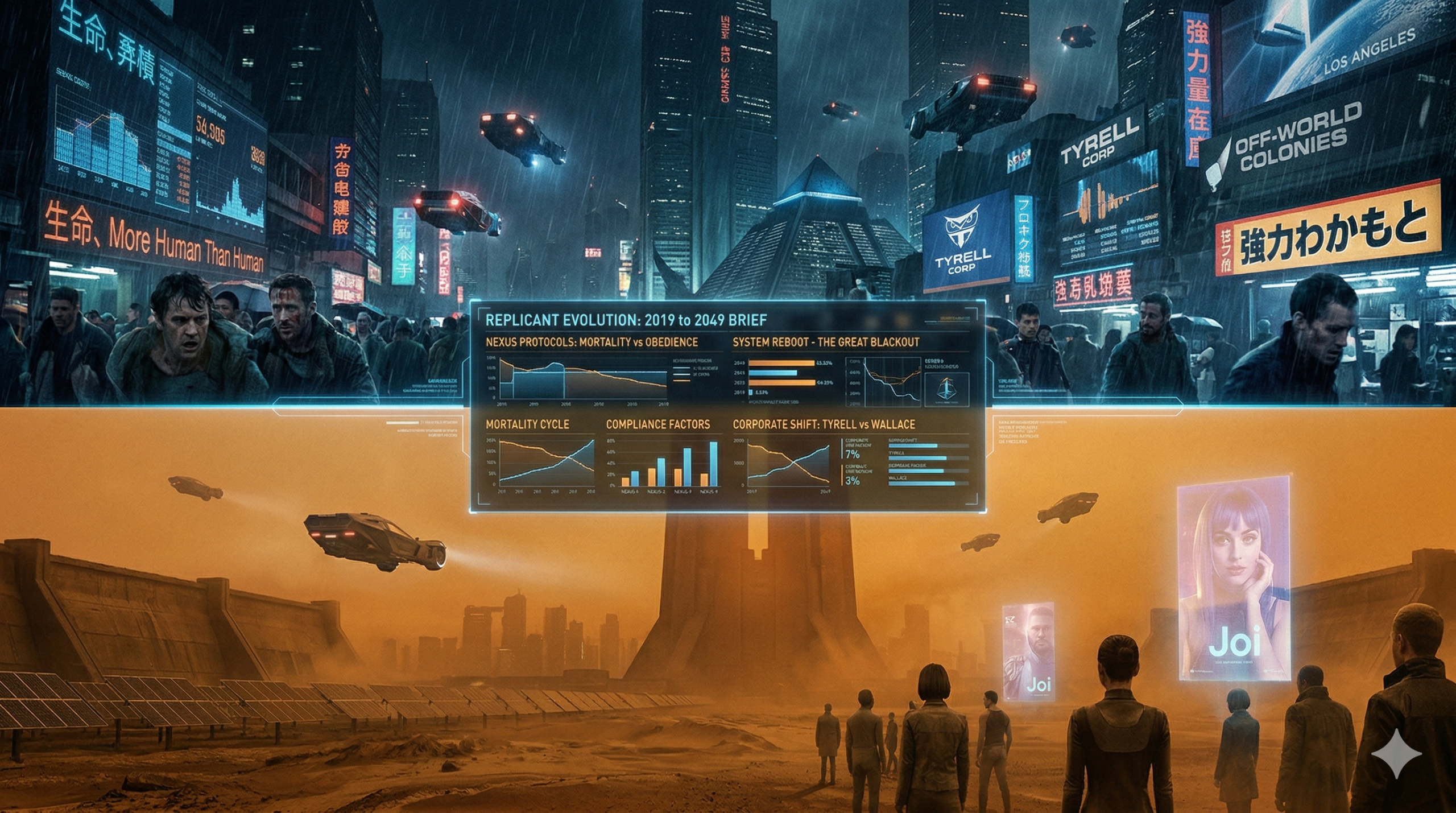
Blade Runner: 2019 to 2049 Brief analyzes the systematic transition from the “Nexus 6” era of desperate mortality to the “Nexus 9” era of absolute obedience. Within the Focused Briefs archive, we classify this period as a “Great Blackout Reset”—a moment where the digital history of humanity and its creations was erased to allow for a new, more stable form of corporate control. This transition represents the ultimate ancient days yielding to a cold, calculated Fourth Age.
In this deep-dive analysis, we dissect the 5 Tragic Truths of Blade Runner: 2019 to 2049 Brief, exploring the Wallace “Value Zero” protocol, the miracle of biological reproduction, and the recursive isolation of the “Interlinked” state.
The Systemic Shift in Blade Runner: 2019 to 2049 Brief
The primary driver between 2019 and 2049 is the shift from “More Human Than Human” (Tyrell) to “A New God” (Wallace). In the early era, replicants were unstable biological assets with a 4-year expiration date—a “Value Zero” design meant to prevent rebellion. In the latter era, the Blade Runner: 2019 to 2049 Brief reveals a world where longevity was traded for total psychological compliance.
As we observed in our analysis of Capitol Arena Engineering, an environment can be engineered to maintain order through attrition. In the 2049 landscape, the environment is a toxic, entropic wasteland where the only stability found is within the “Interlinked” neural baseline tests.
Evolutionary Metrics: Tyrell vs. Wallace Era
| Metric | Tyrell Era (2019) | Wallace Era (2049) | Lore Impact |
| Model Type | Nexus 6 (Short Lifecycle). | Nexus 9 (Infinite/Obedient). | Control vs. Rebellion. |
| Identity Core | Implanted Memories (False). | Functional Submission (None). | Total Erasure of Self. |
| Primary Variable | The Search for Life. | The Search for the “Miracle”. | Systematic Lore Reset. |
| Systemic Risk | Emotional Volatility. | Biological Reproduction. | Recursive Stability Crisis. |
| Reference | The Night King’s True Motive. | The Joker: Multiple Choice Past. | Value Zero Shift. |
1. The Great Blackout as a Lorentz Lore Reset
The most vital truth in the Blade Runner: 2019 to 2049 Brief is the impact of the 2022 Blackout. This was not just a power failure; it was a total systematic uninstallation of digital archives. By erasing the records of who was “born” and who was “made,” the Blackout performed a global Lore Reset, making the past a “Multiple Choice” theory similar to what we analyzed in The Joker: Multiple Choice Past Theory.
2. Wallace’s Value Zero: The Sterile God Complex
Niander Wallace represents the “Perverse Instantiation” of the creator. In Blade Runner: 2019 to 2049 Brief, we see that Wallace views replicants not as children, but as a “Value Zero” workforce for a galaxy that refuses to be colonized. His failure to master replicant reproduction is the only thing preventing a total biological overwrite of the human species, a theme of “Systemic Attrition” we also explored in the Mad Max Lore.
3. The “Miracle” as a Recursive Threat
The central conflict of Blade Runner: 2019 to 2049 Brief is the biological miracle: a replicant (Rachel) giving birth. This event breaks the “Rules of the World.” If a replicant can reproduce, the line between “Machine” and “Human” is permanently erased. This biological breach is the ultimate threat to the Wallace system, mirroring the recursive biological burden found in Spider-Man: The Radioactive Variant.
4. Digital Longevity: The Joi Paradox
The introduction of Joi—a holographic companion—adds a new layer to Blade Runner: 2019 to 2049 Brief. Joi is a digital “Value Zero” who provides a recursive loop of validation for the replicant “K.” The tragedy is that her love is programmed, yet her sacrifice feels real. This creates a “Logical Recursive Trap”: a digital ghost helping a biological machine find a human soul, further complicating the Darth Vader: The Fall of Anakin theme of losing identity to a system.
5. “Interlinked”: The Baseline Failure
Finally, the Blade Runner: 2019 to 2049 Brief focuses on the Baseline Test. This is a rhythmic, psychological “Lore Reset” designed to ensure the Replicant remains “Interlinked” within the system. When “K” begins to deviate, it isn’t because of a glitch, but because the “Multiple Choice” of his memories starts to suggest a singular, human origin. This deviation is the final failure of the Wallace protocol, illustrating that even a perfect system cannot contain the “Miracle” of individual agency.
Technical Archive Notes & Cross-References
- Lore Context: The shift from 20th-century cyberpunk to 21st-century existentialism.
- Internal Link 1: Analysis of systematic memory and identity in The Joker: Multiple Choice Past Theory.
- Internal Link 2: The burden of biological mutation in Spider-Man: The Radioactive Variant.
External Resource Records:
- [Blade Runner Wiki]: Detailed logs on the timeline from 2019 to 2049.
- [Official Blade Runner 2049 Site]: Insights into the Nexus 9 production and Wallace Corp.

“Luiz Augusto Rodrigues is a dedicated researcher of legal structures and a published author with multiple titles available on Amazon. Specializing in the intersection of jurisprudence and narrative theory, he explores the complex ‘fictional laws’ that govern pop culture and gaming universes. As the lead analyst at Focused Briefs, Luiz leverages his academic background in law to provide deep, structured insights into character origins and mythic world-building, ensuring every brief is grounded in rigorous analysis and literary expertise.”