
Table of Contents
- The Bifurcation Point: The Birth of Alternate 1985
- Biff Tannen’s Dictatorship: A Socio-Legal Analysis
- The Failure of the Temporal Safety Protocol
- The Duplicate Object Paradox
- Comparative Lore: Multiverses vs. Single Timelines
- Conclusion: The Fragility of the Present
1. The Bifurcation Point: The Birth of Alternate 1985
The concept of the Alternate 1985 in Back to the Future Part II is rooted in the theory of an elastic timeline. When old Biff delivers the Sports Almanac to his younger self in 1955, he creates a geometric interruption in the space-time continuum. Technically, the universe was “redrawn” from that vector, leading to the creation of the Alternate 1985. This logic of overlapping layers is similar to the dream nesting protocols seen in Inception, where a change at the base level alters all subsequent tiers.
2. Biff Tannen’s Dictatorship: A Socio-Legal Analysis
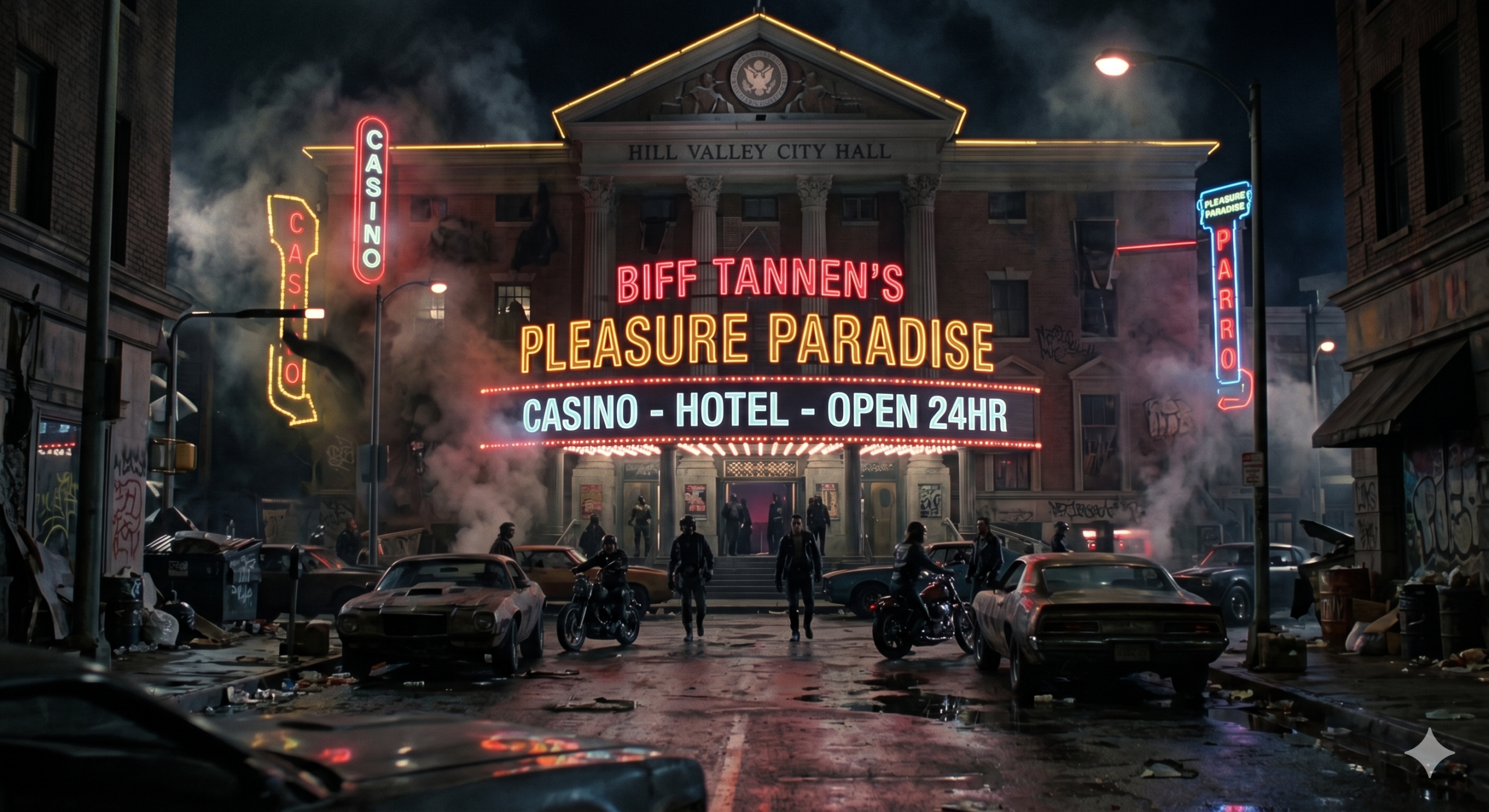
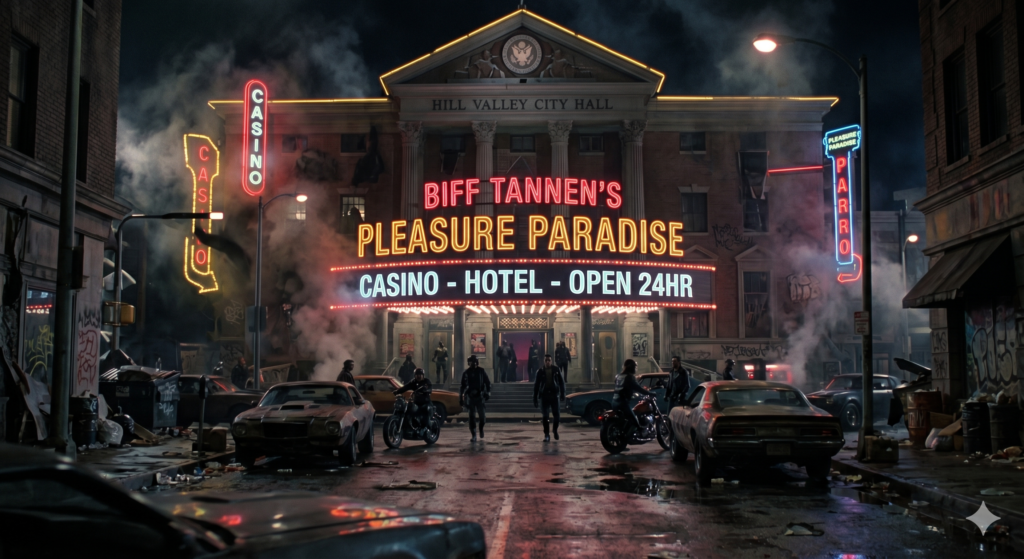
The Alternate 1985 transformed Hill Valley into an autocratic nightmare. From a legal perspective, Biff Tannen didn’t just accumulate wealth; he dismantled the institutions of oversight. In this version of the Alternate 1985, Biff converted City Hall into a casino-hotel, symbolizing the fusion of economic and executive power. The absence of zoning laws represents a scenario of social disintegration, mirroring our analysis of the social collapse in Mad Max.
The analysis of the urban environment within the Alternate 1985 reveals a complete collapse of municipal planning and public safety. The transformation of Hill Valley into a hub of crime and pollution was not accidental, but a direct consequence of the institutional deregulation imposed by Tannen. When observing the streets of the Alternate 1985, we notice that the infrastructure reflects the morality of its ruler: chaotic, privatized, and hostile to the common citizen. This phenomenon of “reverse gentrification” is one of the darkest and most technically detailed aspects of the alternate reality presented in the trilogy, illustrating how power without oversight corrupts the very geography of a city.
3. The Failure of the Temporal Safety Protocol
Why didn’t Marty and Doc disappear immediately upon returning to the Alternate 1985? The answer lies in “Temporal Inertia.” The continuum takes time to process massive biological changes. Unlike other sci-fi tropes, the Alternate 1985 keeps travelers as “temporal outsiders.” They are biological anomalies in the Alternate 1985—a system error in the universe’s database.
4. The Duplicate Object Paradox
The simultaneous existence of two Almanacs in the Alternate 1985 creates a risk of collapse due to information density. If “Almanac B” is destroyed, the Alternate line loses its root cause. This cause-and-effect mechanic is as rigorous as the Shinigami Code rules in Death Note, where a specific action triggers an inevitable sequence of systemic events.
5. Comparative Lore: Multiverses vs. Single Timelines
In the Alternate 1985, the character lineages were corrupted. George McFly’s fate in the Alternate 1985 is a tragic example of how external changes nullify character development. This manipulation of lineage echoes themes seen in our brief on Rey’s parents in Star Wars, where the past is rewritten to serve a new narrative purpose within the framework.
From the standpoint of temporal ethics, the existence of the 1985 places Doc Brown in an unprecedented dilemma regarding civil and existential responsibility. As a scientist, he must decide whether restoring the original timeline constitutes an act of salvation or a form of “systemic erasure” against those who now only exist within the Alternate 1985.
This heavy burden regarding the fate of an entire reality is what defines the tone of urgency in the second film, proving that manipulating the past to create or destroy the Alternate 1985 carries human and ethical costs that no time machine can fully mitigate. The struggle to revert the Alternate era is not just a fight for survival, but a complex debate on the permanence of historical consequences.
6. Conclusion: The Fragility of the Present
The Alternate 1985 serves as a technical warning about the fragility of social and temporal structures. Marty and Doc prove that the timeline isn’t fixed but is an editable document. For more data on the production of this timeline, check the Back to the Future Wiki. In the end, the Alternate age remains the ultimate cautionary tale of timeline tampering.

“Luiz Augusto Rodrigues is a dedicated researcher of legal structures and a published author with multiple titles available on Amazon. Specializing in the intersection of jurisprudence and narrative theory, he explores the complex ‘fictional laws’ that govern pop culture and gaming universes. As the lead analyst at Focused Briefs, Luiz leverages his academic background in law to provide deep, structured insights into character origins and mythic world-building, ensuring every brief is grounded in rigorous analysis and literary expertise.”