
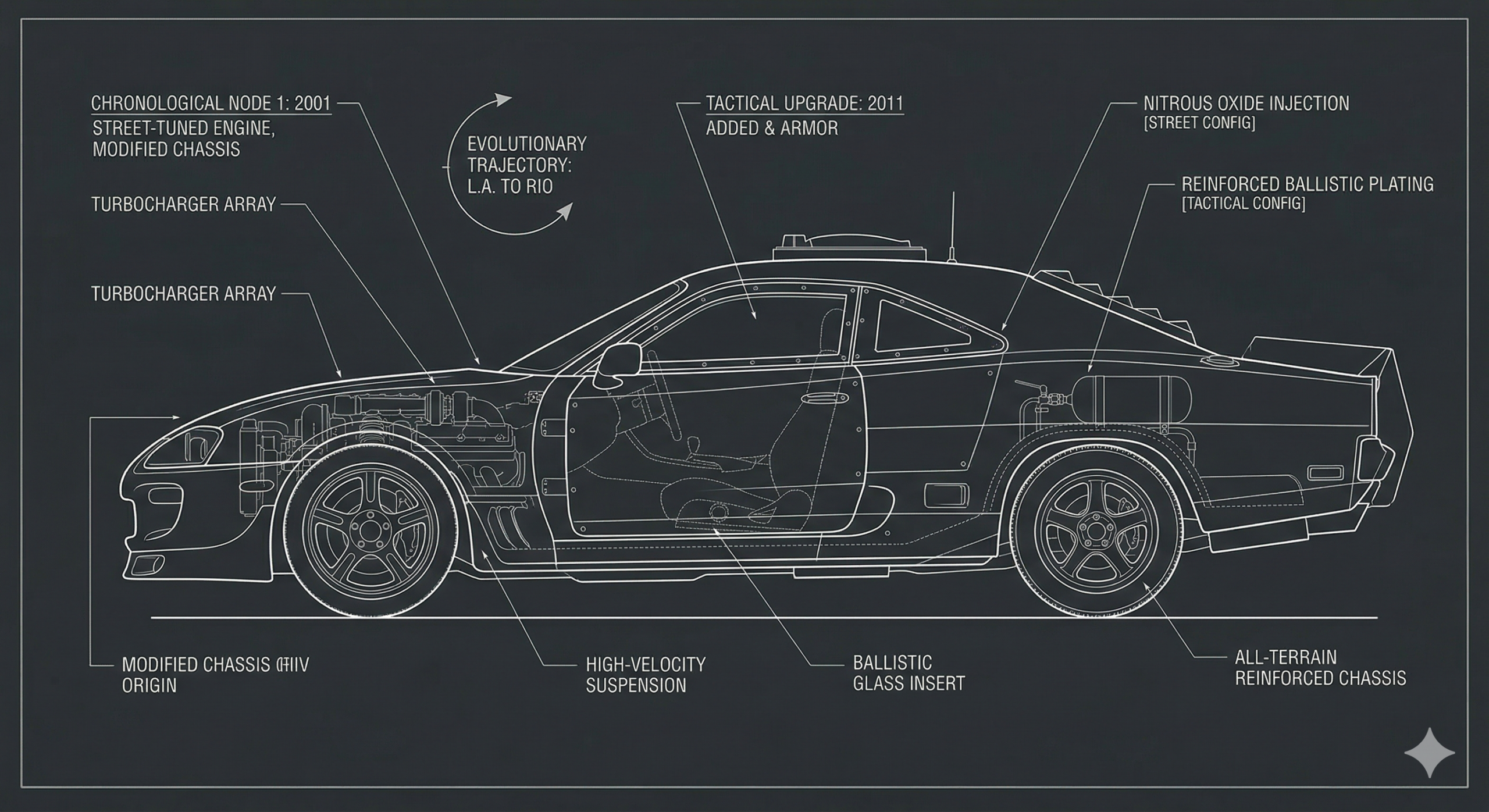
The analysis of the Fast & Furious: Chronological Order reveals a significant “Non-Linear Displacement” in its narrative directory. Within the framework of the Fast & Furious: Chronological Order, the release dates do not align with the systemic timeline, primarily due to the “Tokyo Drift Anomaly.” To master the Fast & Furious: Chronological Order, one must synchronize the events of the mid-2000s with the tactical shifts of the 2010s to maintain logical continuity.
Systemic Timeline: Fast & Furious: Chronological Order
| Sequence | Archive Title | Primary Directive | Systemic Impact |
| 01 | The Fast and the Furious (2001) | Low-level Hijacking. | Core Team Assembly. |
| 02 | 2 Fast 2 Furious (2003) | Narcotics Infiltration. | Expansion of Logistics. |
| 03 | Fast & Furious (2009) | Cartel Extraction. | Re-synchronization. |
| 04 | Fast Five (2011) | Rio Heist Operations. | Transition to Tactical. |
| 05 | Fast & Furious 6 (2013) | Counter-Mercenary. | Global Visibility. |
| 06 | The Fast and the Furious: Tokyo Drift (2006) | Localized Drift Racing. | The Han Paradox. |
| 07 | Furious 7 (2015) | God’s Eye Recovery. | High-Value Targeting. |
| 08 | The Fate of the Furious (2017) | Cyber-Terrorism Defense. | Internal Breach. |
| 09 | Hobbs & Shaw (2019) | Biological Threat. | Systemic Branch. |
| 10 | F9: The Fast Saga (2021) | Project Aries. | Space-Grade Recon. |
| 11 | Fast X (2023) | Dante’s Retribution. | Pending System Failure. |
1. The Tokyo Drift Anomaly: Non-Linear Synchronization
The most complex variable in the Fast & Furious: Chronological Order is the placement of Tokyo Drift. Although released in 2006, technical data confirms it occurs between Fast & Furious 6 and Furious 7. This “Temporal Buffer” was necessary to explain the persistence of the Han Lue asset. Following the events of the London operation (FF6), Han relocated to Tokyo, where his perceived “deletion” triggered the revenge protocol of Deckard Shaw, a concept of fixed chronological points we explored in Endgame Time Travel Rules.
2. The Short Film Data Packets: Turbo Charged & Los Bandoleros
To achieve 100% data integrity in the Fast & Furious: Chronological Order, two critical “Lore Patches” must be included. The Turbo Charged Prelude (2003) explains the transit between L.A. and Miami, while Los Bandoleros (2009) serves as the “Systemic Bridge” between the second and fourth films. Without these packets, the transition of Brian O’Conner from a fugitive to an FBI asset remains an “Incomplete File.”
3. From Street Racing to Tactical Warfare
The Fast & Furious: Chronological Order highlights a radical shift in the franchise’s “Operating System.” The early timeline (Films 1-3) focuses on localized racing and low-level crime. However, starting with Fast Five, the team underwent “Asset Hardening,” transforming from street racers into a high-precision tactical unit capable of executing complex heists and international espionage. This evolution mirrors the biological and tactical optimization seen in the Spartan II Project.
4. The Cipher Infiltration: Cyber-Logic and Betrayal
In the latter half of the Fast & Furious: Chronological Order, the primary threat transitions from physical force to cyber-warfare. The introduction of Cipher represents a “Systemic Virus” capable of manipulating global infrastructure. This era focuses on the vulnerability of hardware (The God’s Eye, nuclear subs) and the psychological stress-testing of the “Family” protocol, a theme of structural integrity we analyzed in the League of Shadows Origin.
5. The Dante Reyes Feedback Loop: Fast X
The current entry in the Fast & Furious: Chronological Order—Fast X—serves as a “Return to Data Root.” By referencing the events of Fast Five (the Rio Heist), the timeline creates a feedback loop where past actions directly corrupt the present. This “Legacy Conflict” suggests that the franchise is moving toward a total “Systemic Reset,” where the original assets must face the long-term consequences of their high-velocity trajectory.
Technical Summary: Managing the Velocity
In conclusion, the Fast & Furious: Chronological Order is a study of exponential growth and narrative re-synchronization. By treating the Tokyo Drift anomaly as a fixed pivot point, the timeline remains logically sound. As the archive moves toward the final chapters, the integrity of the “Family” remains the only stable variable in a world of shifting technological and geopolitical threats.
Technical Archive Notes & Cross-References
- Pillar Link: Historical resets and timeline continuity in The Witcher: Continent History Brief & Timeline.
- Cluster Link: Tactical asset evolution and physical hardening in the Spartan II Project.
- Bridge Link: Non-linear chronology and paradox management in Endgame Time Travel Rules.
External Resource Records:
- [Universal Official]: Technical specs for Fast X Assets.
- [Fast Saga Wiki]: Complete history of the Timeline Displacement.

“Luiz Augusto Rodrigues is a dedicated researcher of legal structures and a published author with multiple titles available on Amazon. Specializing in the intersection of jurisprudence and narrative theory, he explores the complex ‘fictional laws’ that govern pop culture and gaming universes. As the lead analyst at Focused Briefs, Luiz leverages his academic background in law to provide deep, structured insights into character origins and mythic world-building, ensuring every brief is grounded in rigorous analysis and literary expertise.”