
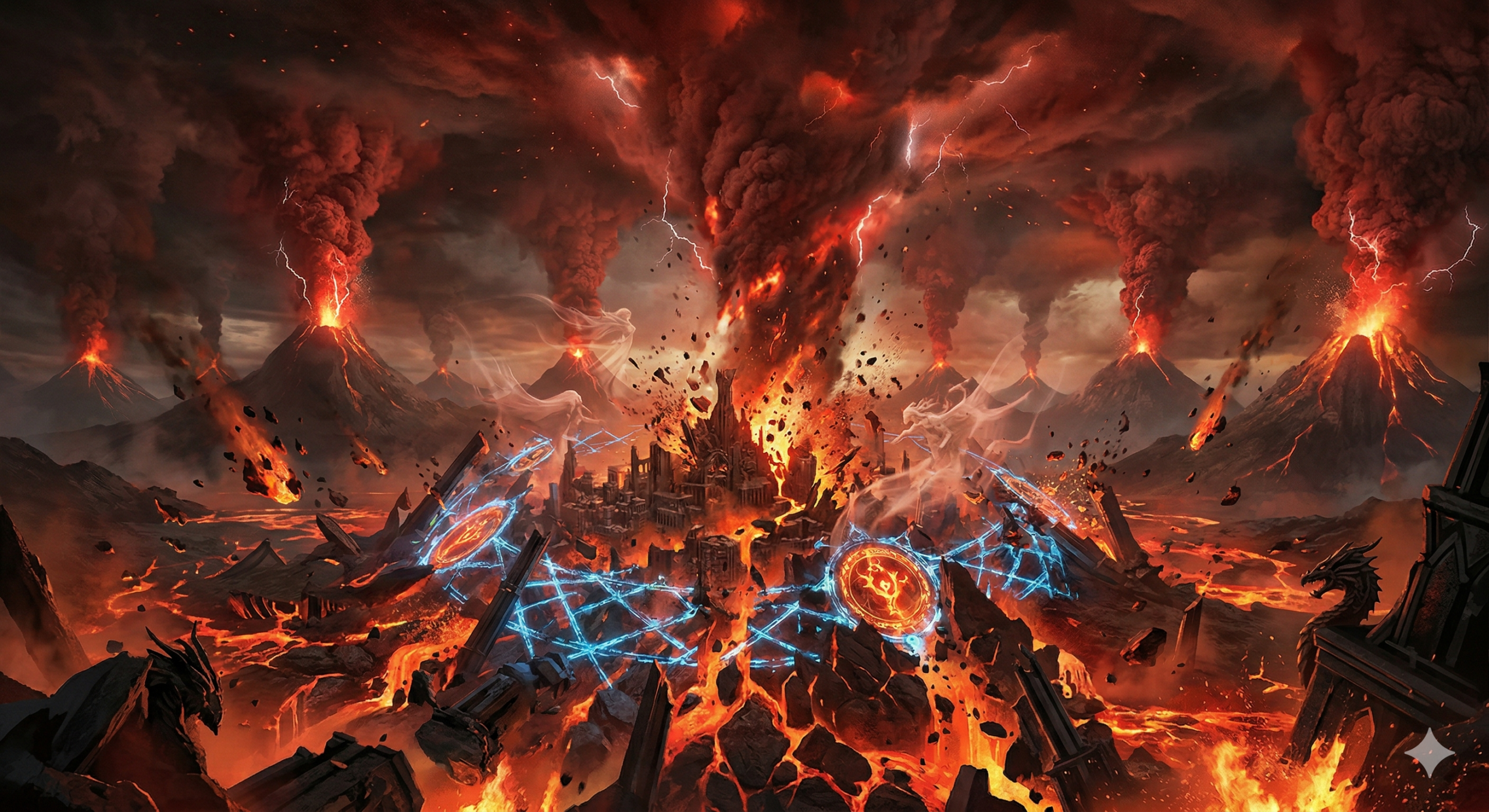
For thousands of years, the Valyrian Freehold held the known world in a grip of obsidian and blood. They did not just dominate; they defined reality through a mastery of blood magic, dragonlord hierarchy, and a form of engineered geology that stabilized the formidable volcanic mountain range known as the Fourteen Flames. Yet, in a single night of absolute, recursive cataclysm, it all burned. The history of Westeros and Essos is defined by the absolute absence left by the Doom of Valyria.
In this exhaustive deep-dive brief, we deconstruct the hidden structural weaknesses and targeted systematic intervention that likely triggered the Doom of Valyria. This wasn’t a natural disaster; it was a total Doom of Valyria, a final logical recursion of extreme, specialized magic and engineered structural instability. We analyze the Tectonic Prison of the Fourteen Flames, the targeted assassination of the fire mages, the role of the Faceless Men, and the inherent failure of a recursive magical loop.
The Algorithm of Stability: The Fourteen Flames as Engineered Tectonics
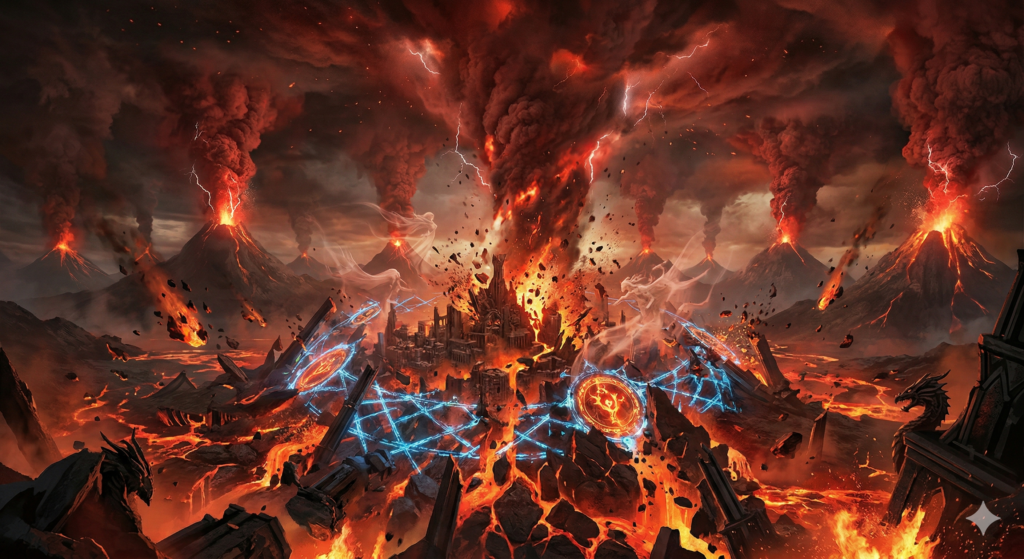
To understand the Doom of Valyria, we must first analyze the Valyrian stabilization method. The Fourteen Flames were not random volcanoes; they were a structured, engineered geothermal prison. Valyrian mages utilized specialized blood magic to “bind” the pressure of the Fourteen Flames, preventing massive, cyclical eruptions in exchange for a constant, manageable bleed of geothermal energy and obsidian.
This creation of an engineered natural system is where the Freehold’s structural hubris lay. A system that relies on constant, manual (or rather, magical) intervention to maintain an unnatural state of balance is inherently fragile. As we analyzed in our Three Laws of Robotics (Asimov Paradox) breakdown, the pursuit of total, automated control through rigid logic (be it ethical commands or blood magic containment) inevitably creates a recursive “Inaction Trap.” The Doom of Valyria was the ultimate structural realization of this trap: when the system designed to prevent the disaster becomes the disaster, total collapse is mandatory.
Structural Instability: Engineered Tectonics vs. Natural Geology
| Metric | Natural Tectonics | Engineered fourteen Flames | Valyrian Maintenance |
| Stability Method | Cyclical Geologic Release | Unnatural Blood-Magic Binding | Constant, localized bleed-off. |
| Pressure Mgmt. | Dynamic and uncontained. | Managed and constrained. | Recursive sacrifice ritual. |
| Primary Risk | Major random eruption. | Engineered systematic collapse (Doom of Valyria). | Assassination of maintenance mages. |
| Lore Comparison | The unstable volcanic activity of Skaagos. | The recursive feedback loop of Skynet (Terminator). | The failure of the Zeroth Law (Asimov). |
1. Targeted Assassination: Shattering the Stabilization Protocol
The most common, and likely the most accurate, theory regarding the Doom of Valyria is not that the volcanoes erupted naturally, but that the intervention preventing them was destroyed. According to high-authority sources on A Song of Ice and Fire Wiki – Doom of Valyria, Valyrian histories hint at several mages—the highly specialized “stabilization caste”—being assassinated in rapid succession.
This was not a random act of terrorism; it was a targeted, surgical strike. These mages were the “human hardware” maintaining the magical-tectonic algorithm. If you remove the processor designed to manage the critical geothermal pressure, the system doesn’t just fail; it enters a logical failure loop where the accumulated, compressed pressure releases simultaneously. The Doom of Valyria was the catastrophic instantiation of a total structural collapse of an unmonitored, unstable environment.
2. The Role of the Faceless Men: Biological and Systematic Intervention
The entity most likely responsible for this targeted intervention is the shadowy organization known as the Faceless Men. The origins of the Faceless Men are inextricably tied to Valyria; their order was born in the deep mines of the Freehold, founded on the principle that valar morghulis (all men must die) as a mercy against the brutal, unnatural slavery of Valyrian rule.
Their first target, according to The World of Ice and Fire, was not the slave masters, but the Valyrian fire mages holding back the fourteen flames. By targeting these specific mages, they did not just grant “the gift of death” to individuals; they granted death to the entire recursive system of the Freehold. This systematic intervention mirrors the tragic, recursive loops we analyzed in our Terminator Judgement Day brief. The Faceless Men did not create Judgement Day (the Doom of Valyria); they simply accelerated the inevitable recursive failure that Valyria had engineered into its own structural architecture.
3. The Failure of Recursive Power: The Value of Absolute Sacrifice
The entire Valyrian Freehold operated on a principle of recursive escalation. Their dragons grew larger, their blood magic required greater sacrifices, and their containment of the Fourteen Flames demanded increasingly complex, specialized blood-magic maintenance. This creates a logical paradox: a system that requires increasing energy (blood and life) just to maintain the status quo is not a stable system; it is a pyramid scheme of power, destined to collapse.
This structural recursion is what we term “The Value of Absolute Sacrifice.” The Doom of Valyria was the definitive moment where the “value zero” of that sacrifice (the removal of the maintenance mages) rendered the Freehold’s entire structured reality logically contradictory and void. It proves that a structure founded on unnatural, unstable dominance cannot exist without the specific intervention designed to prevent its own logical collapse, illustrating that the pursuit of absolute magical control is a recursively unstable algorithm of doom.
4. Systemic Breakdown: The Cascade Failure
When the key mages were assassinated, the engineered system of the Fourteen Flames did not just “erupt”; it experienced a massive cascade failure. In a natural volcanic eruption, a single mountain releases pressure. During the Doom of Valyria, all fourteen major volcanoes erupted simultaneously, because the entire magical infrastructure containing them simultaneously went offline.
This simultaneous eruption caused the mountains themselves to turn to ash, the sea to boil, and entire islands to crack and sink. This is not a description of a natural disaster; it is a description of a decentralized, engineered geothermal grid experiencing a single, synchronized point of ultimate failure. The Doom of Valyria was a technical cataclysm where every node in a dangerous network collapsed simultaneously, maximizing rather than mitigating the disaster.
5. Lorentz Lore Connection: The Doom Paradox
Ultimately, the Doom of Valyria exists as the defining narrative vacuum in the Lorentz-Lore structure of George R.R. Martin’s universe. It is a necessary trauma, ensuring that the ancient, overwhelming magic of Valyria (blood magic, mass-produced steel, dragon domination) cannot exist in the Fourth Age, except through diluted remnants.
This necessary, tragic void mirrors the irreversible logic loop of memory and loss we analyzed in our breakdown of the Tolkien Entwives: Tolkien’s Greatest Mystery, where a fundamental separation (from reality or their counterparts) leads to an endless, futile search for a lost ideal. For the survivors of Valyria, the Freehold itself is the Entwife—a lost, symmetrical order that can never be reconciled with the broken, magical-geological wilderness they are now trapped in. The Doom of Valyria ensures that the “perfect” recursive organism of the Freehold must always be a tragedy defined by its own final, catastrophic failure of logical containment.

“Luiz Augusto Rodrigues is a dedicated researcher of legal structures and a published author with multiple titles available on Amazon. Specializing in the intersection of jurisprudence and narrative theory, he explores the complex ‘fictional laws’ that govern pop culture and gaming universes. As the lead analyst at Focused Briefs, Luiz leverages his academic background in law to provide deep, structured insights into character origins and mythic world-building, ensuring every brief is grounded in rigorous analysis and literary expertise.”