
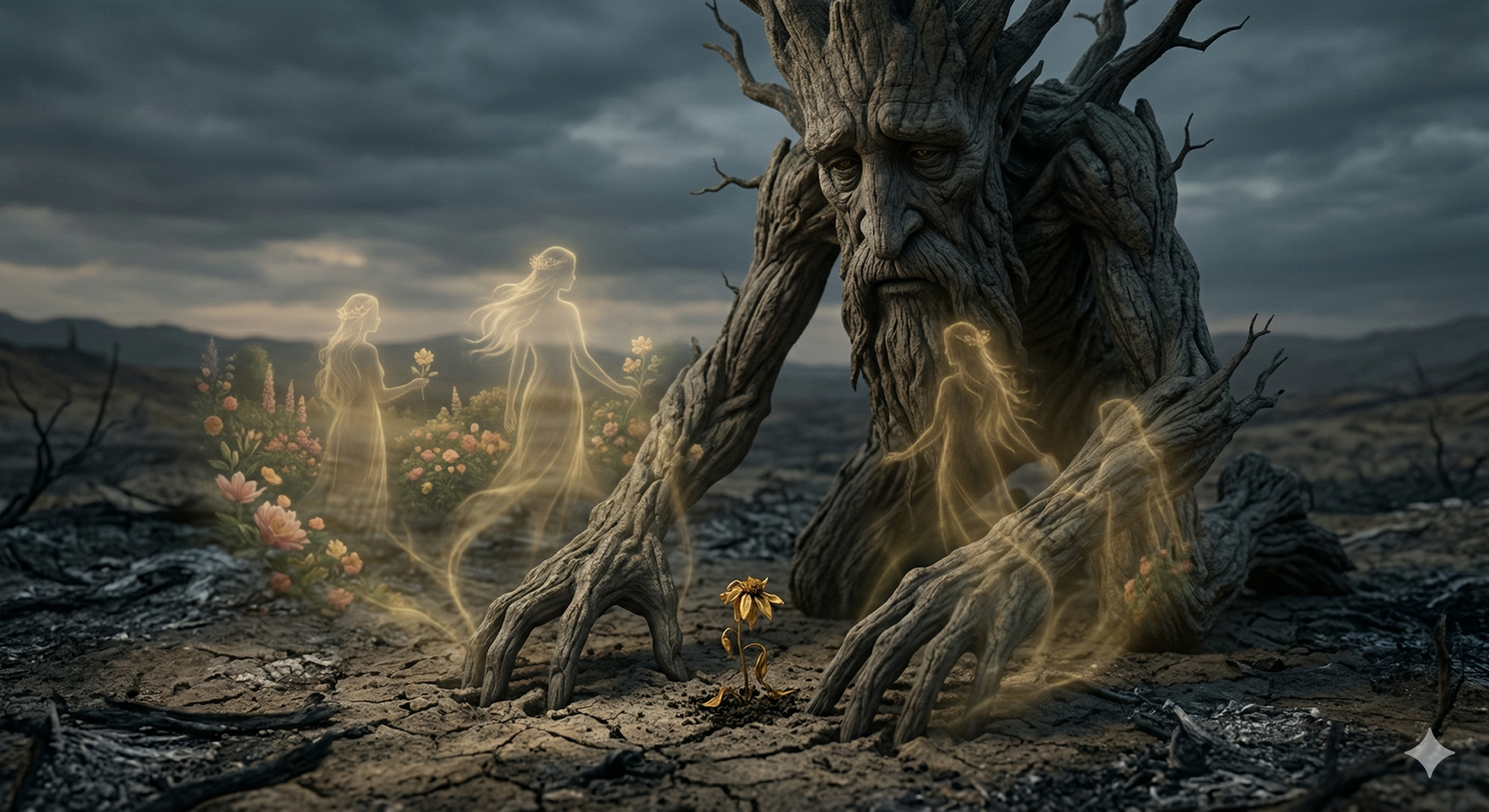
In J.R.R. Tolkien’s vast Middle-earth, the Entwives represent a unique, devastating tragedy. Unlike the fiery chaos of Morgoth or the structured cruelty of Sauron, their fate is defined by a slow, crushing absence. Their mystery is not a puzzle to be solved; it is a fundamental trauma. The loss of these figures represents a quiet, agonizing fracture in the natural order of Middle-earth, symbolizing the inevitable decline and inevitable fragmentation of the ancient world.
In this deep-dive brief, we analyze the philosophical dissonance between Ents and the Entwives, the strategic reason Sauron likely targeted them, and the profound environmental grief that defines their legacy. Their mystery is perhaps Tolkien’s most visceral exploration of irreversible loss.
The Algorithm of Dissonance: The Separation of Ideal and Function
To understand the tragedy of the Entwives, we must analyze the structural breakdown of the ancient companionship between the tree-herders. They were not simply partners; they represented two distinct, necessary functions of nature that ultimately became incompatible. The Ents focused on raw, chaotic wilderness and the preservation of wild trees. Their lost counterparts, however, were pulled toward order, cultivation, and symmetry.
This semantic dissonance—wild nature versus cultivated structure—led to a fundamental separation of function. While Ents guarded the wild woods, Tolkien’s agriculturalists became the first to define “civilization” in a non-man/non-elf context. This fundamental shift effectively created a new species identity focused solely on order.
Dissonance of Nature: Ents vs. Entwives
| Metric | Ents | Entwives |
| Philosophical Focus | Chaos / Raw Wilderness | Order / Symmetry / Agriculture |
| Primary Domain | Wild Forests (e.g., Fangorn) | Cultivated Gardens (e.g., Brown Lands) |
| Relationship to Earth | Keepers / Herders | Planters / Harvesters |
| Reaction to Sauron | Direct Conflict (e.g., Isengard) | Tragic Elimination (War of Last Alliance) |
1. The Brown Lands: Strategic War of Attrition
The primary domain of the Entwives, the gardens they meticulously cultivated, was located in what is now known as the “Brown Lands” along the Anduin river. During the War of the Last Alliance, this prosperous region was scorched by Sauron.
This attack was not collateral damage; it was a visceral act of environmental warfare. By destroying the cultivated gardens of these beings, Sauron did not just target a food supply. He targeted a competing form of ordered power. A machine-based industrial entity, such as Sauron’s war machine (analyzed in our Terminator Judgement Day briefing), will always find cultivated nature a direct ideological threat.
In our breakdown of the Three Laws of Robotics, we discussed how simple logical commands (like Sauron’s) often lead to absolute destruction, mirroring the total logical wipeout of the Brown Lands. Sauron’s algorithm required a totally automated hierarchy, something these gentle environmental managers could not exist independently of.
2. Tolkien’s Post-Script: The Failure of Reconciliation
Perhaps the most tragic aspect of the Entwives mystery is that Tolkien never intended them to be found. They were a necessary, existential grief, not a puzzle to be resolved. The Ents themselves recognize that they will likely never return to Fangorn; instead, they hope that one day they will find a new home together—a future that Tolkien himself ultimately deemed a structural failure.
In The Letters of J.R.R. Tolkien, he explicitly states: “I think that in fact the Entwives had disappeared for good, being destroyed with their gardens in the War of the Last Alliance.” He later expands on this tragic conclusion, suggesting that even if some survived, they would be irrevocably changed by their trauma, making reconciliation between the wild Ents and their now likely broken (or perhaps enslaved) counterparts philosophically and physically impossible. There is no happy ending for these figures.
3. The Search: A Tragic Case of Misaligned Priority
The Ents spend centuries searching for the Entwives, a tragic loop of hope and failure that mirrors other tragic, looping timelines like those in our Terminator Judgement Day brief. However, the fundamental problem with the search for these beings is that the Ents prioritize finding them over understanding the systematic reason they were lost.
The Ents focus on a physical reunion in the wild forests, ignoring that the Entwives were defined fundamentally by order, symmetry, and agricultural structure. These ancient Entwives did not share the Ents’ love for chaotic wildwoods; they sought to domesticate the land, creating meticulously cultivated gardens. By searching solely in the conceptual space of the wilderness, the Ents are looking in the wrong philosophical dimension. Their expectation of finding a domesticated group living naturally within a wild, uncultivated setting is a fundamental miscalculation of identity, rooted in a deep-seated denial of how complete the separation between them had become.
If any form of these missing figures still exists in the Fourth Age, they have likely been irrevocably broken into a form the Ents wouldn’t recognize—a tragic process mirroring the systematic loss of humanity by machines in our Terminator Judgement Day analysis.
They may have been totally consumed or overwritten by the machine-based, logical systems of Sauron (like the rigid ethical frameworks from our Three Laws of Robotics (Asimov Paradox) breakdown), rendered unrecognizable by the Dark Lord’s brutal ordering. They cannot exist in the chaotic, magical wilderness that the Ents call home, which aligns more with the esoteric natural magic we discussed in our Dr. Strange Magic Rules analysis. Their simple, emotional search is a direct consequence of this failure of deep narrative analysis.
Internal Briefing & Related Files
- Lore Context: The environmental decline of the Third Age.
- See also: Our breakdown of Terminator Judgement Day Date: 5 Tragic & Vital Timelines.
- Reference: Analysis on the Three Laws of Robotics (Asimov Paradox).

“Luiz Augusto Rodrigues is a dedicated researcher of legal structures and a published author with multiple titles available on Amazon. Specializing in the intersection of jurisprudence and narrative theory, he explores the complex ‘fictional laws’ that govern pop culture and gaming universes. As the lead analyst at Focused Briefs, Luiz leverages his academic background in law to provide deep, structured insights into character origins and mythic world-building, ensuring every brief is grounded in rigorous analysis and literary expertise.”